 Concerts, festivals, film, and the culture around them.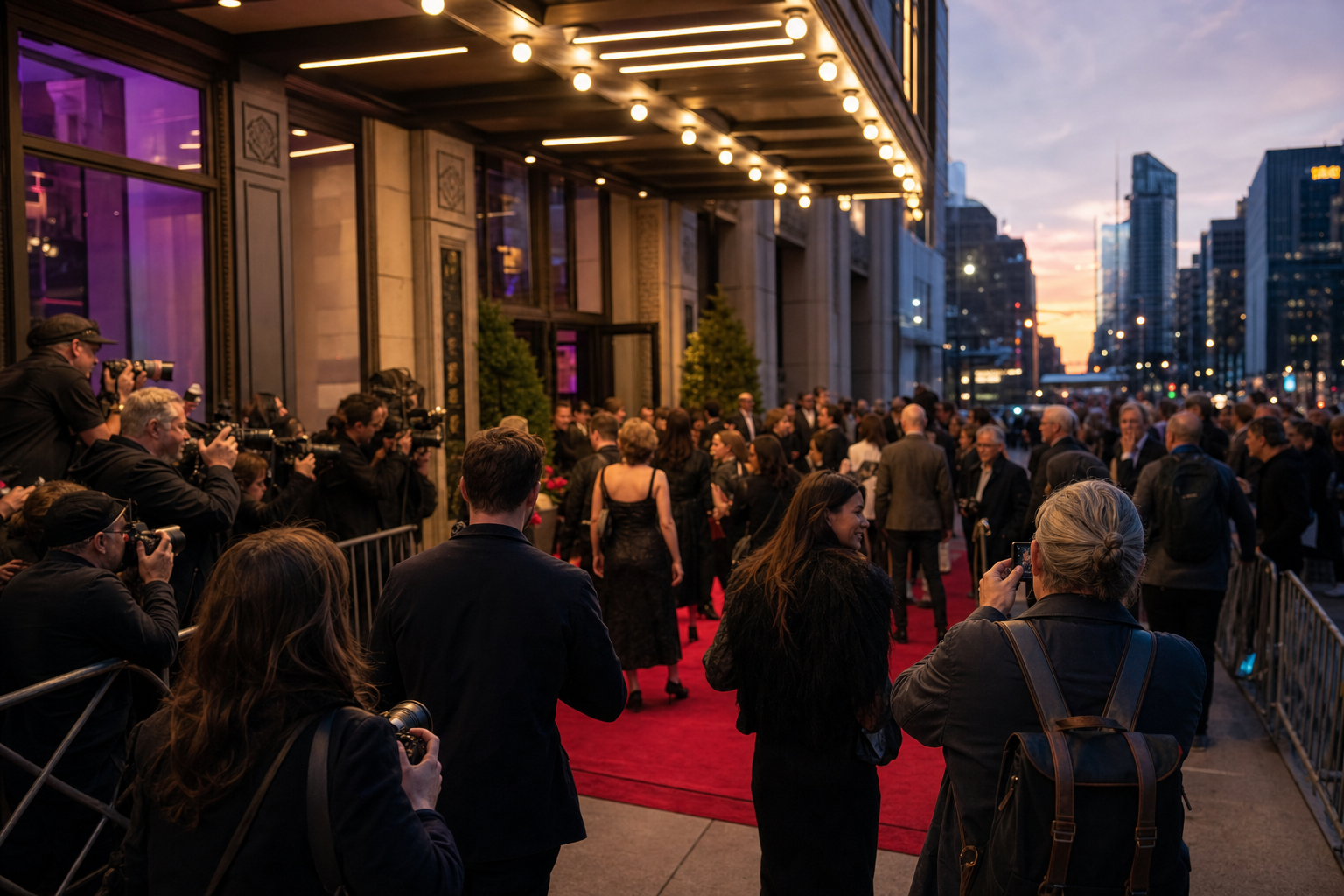
Tribeca 2025 opened the way New York likes to recognize itself: in a grand old room, through a hometown musician, with the city playing supporting character. On June 4, the world premiere of Susan Lacy and Jessica Levin's two-part documentary Billy Joel: And So It Goes filled the Beacon Theatre, placing a Long Island songwriter at the front of a festival created to help restore Lower Manhattan's cultural pulse after September 11.
That opening set the tempo for a festival that no longer fits comfortably inside the word film. From June 4 through 15, Tribeca moved through cinema, music, television, audio, games, talks, and immersive work. Its feature program alone contained 118 films from 36 countries, including 94 world premieres and 44 feature debuts, selected from a record 13,541 submissions. The scale was large, but the daily experience documented around it was still built from small rituals: a ticket checked, a seat found, a filmmaker introduced, and a conversation continuing after the lights came up.
A lineup that moved like the city
Music was not a sidebar in 2025; it was the connective tissue. Miley Cyrus brought the world premiere of the visual album Something Beautiful and stayed for a conversation. Billy Idol, Becky G, and Eddie Vedder paired film premieres with live performances, while members of Metallica, Depeche Mode, Wizkid, and Ty Dolla $ign joined post-screening discussions. The Rose: Come Back to Me, Rebbeca, and documentaries involving Counting Crows and Culture Club extended that idea across generations and genres.
The narrative slate offered a different kind of recognition. Tow brought Rose Byrne, Demi Lovato, and Octavia Spencer into a story about a woman fighting a towing company. The Best You Can reunited Kevin Bacon and Kyra Sedgwick as co-stars for the first time in two decades. Rosemead, Dragonfly, Everything's Going to Be Great, She Dances, Sovereign, and Deep Cover gave the schedule the density of a city block: established performers at one door, first-time directors at the next. The closing-night selection, Yanuni, shifted the final spotlight toward Indigenous Brazilian activist Juma Xipaia and the defense of the Amazon.
Tribeca worked best when the distance between a celebrity premiere and a first feature collapsed into the length of one subway ride and one conversation in a theater lobby.
The atmosphere between screenings
Read together, the official schedule and published attendee accounts describe a festival powered by contrast. The Beacon Theatre could hold a Billy Joel premiere or a Casino anniversary conversation with Robert De Niro and Martin Scorsese; SVA Theatre, BMCC, AMC locations, Spring Studios, and Brooklyn Bowl carried audiences into more intimate screenings, shorts programs, reunions, and live events. The geography kept changing the scale of the encounter.
Post-festival coverage described an energetic Lower Manhattan buzz and an organization that remained smooth and welcoming even with the ordinary chaos of a major festival. The public record suggests an atmosphere less like one continuous red carpet than a sequence of overlapping rooms: photographers gathering near a premiere entrance, badge holders comparing schedules, audiences recalibrating after a politically charged documentary, and music fans arriving with the volume of a concert crowd. This is reconstructed scene-setting, but it matches the program's defining tension between access, celebrity, discovery, and New York motion.
The archive became a live event
Tribeca's anniversary screenings were not passive repertory bookings. Casino returned for its 30th anniversary with De Niro and Scorsese in conversation. Meet the Parents marked 25 years with De Niro, Ben Stiller, and producer Jane Rosenthal. Best in Show reunited Christopher Guest and members of the cast, while Requiem for a Dream brought Darren Aronofsky and Ellen Burstyn back to the film that still leaves audiences wrung out.
Elsewhere, Paris Is Burning received a 35th-anniversary screening with a live voguing performance, Martin Scorsese introduced a 35mm presentation of Kundun, and a restoration of Linda Linda Linda continued later at Brooklyn Bowl with a live set by the Linda Lindas. Those choices made memory active. The point was not only to admire a known film but to put it back into a room where artists and audiences could change its temperature together.
The awards shifted attention toward discovery
By June 12, the competition winners had redrawn the festival's hierarchy. Libby Ewing's Charliebird won the Founders Award for Best U.S. Narrative Feature, and Gabriela Ochoa Perez received the category's performance award. Sarah Goher's Egyptian drama Happy Birthday won Best International Narrative Feature, international screenplay honors, and the Nora Ephron Award. Suzannah Herbert's Natchez, a film about the contested presentation of history in a Mississippi tourism economy, took Best Documentary Feature.
The field widened from there. Andrea Riseborough and Brenda Blethyn shared the international performance award for Dragonfly. A Bright Future won the Viewpoints Award. Cristian Carretero and Lorraine Jones Molina received Best New Narrative Director for Esta Isla, while Augusto Zegarra won the Albert Maysles Award for Best New Documentary Director for Runa Simi. Tribeca's official tally noted that every winner in the U.S. narrative competition came from a first-time director, a useful counterweight to the festival's celebrity scale.
The shorts program reinforced that pipeline. Tribeca screened 93 shorts, including 82 competition titles and ten music videos, and opened a dedicated Shorts Cinema at Spring Studios. Beyond Silence won Best Narrative Short, I hope this email finds you well won Best Documentary Short, Playing God took animation honors, and LL Cool J's Rock The Bells became the festival's first Music Video Jury Competition winner.
What the 2025 festival left behind
Tribeca 2025 was several festivals occupying the same calendar. It was a music-documentary showcase, a launchpad for independent features, a home for shorts, a reunion circuit, an industry gathering, and a New York social event. That breadth could feel unruly, but it also allowed an audience to move from a familiar name toward a film with no reputation yet.
The most convincing image of the festival is therefore not one carpet or one winner. It is the reset between events: leaving a room where cinema history has just been discussed, crossing the city, and entering another where a first-time filmmaker is waiting to see whether a new audience will follow. Tribeca's 2025 program made those experiences neighbors.